
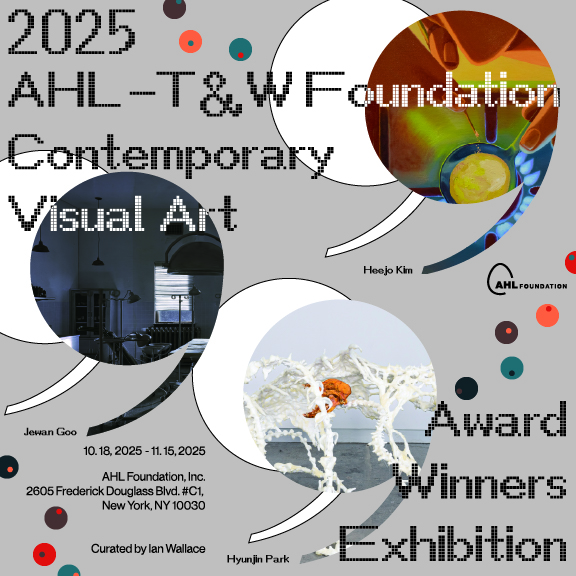
2025 AHL-T&W Foundation Contemporary Visual Art Awards Exhibition
Juried by Ian Wallace, Jeffrey Lee, and Leeza Meksin
Curated by Ian Wallace
- Featuring Jewan Goo, Heejo Kim, and Hyunjin Park
- Exhibition Dates: October 18 – November 15, 2025
- Gallery Hours: Wednesday–Saturday, 12–6 PM
- Opening Reception: Saturday, October 18, 3–5 PM
- Venue: AHL Foundation, 2605 Frederick Douglass Blvd. #C1, New York, NY 10030
View the digital version of the exhibition catalog
Opening Reception and Exhibition View (To be updated)
Curatorial Statement
“Presence,” in the now, is an inherently unstable thing: images of ourselves, of others, of things and events circulate across screens where they are fragmented, repeated, and hybridized until they lose coherence. To “appear” under such conditions is partial, contingent, and unstable. The three artists shortlisted for this year’s Visual Art Award—Jewan Goo, Hyunjin Park, and Hejoo Kim—engage this instability from different angles and, from different perspectives, their works lean into and strategically mine the fractured relationship between representation and truth. Each moves away from traditional notions of the figure as a stable anchor of meaning, instead experimenting with occlusion, flattening, abstraction, and hybridization to probe new modes of visibility, memory, and relation.
Of course, presence has long been theorized as unstable—Walter Benjamin famously wrote of the loss of “aura” in mechanically reproduced images in 1935, and more recently, writers like Boris Groys have discussed the image as a thing endlessly circulated, compressed, and degraded. But the conditions of the present sharpen and intensify that instability in unprecedented ways. Today, with AI-generated imagery, deepfakes, and algorithmically targeted feeds, even the boundary between the fabricated and the documentary is increasingly indistinguishable. To appear in this shattered hall of mirrors is not simply to be seen but to be sorted, datafied, and consumed. It is against this backdrop that Goo, Park, and Kim might be situated—each probing how images and figures might still hold space for memory, relation, and critique when presence itself can no longer be taken for granted.
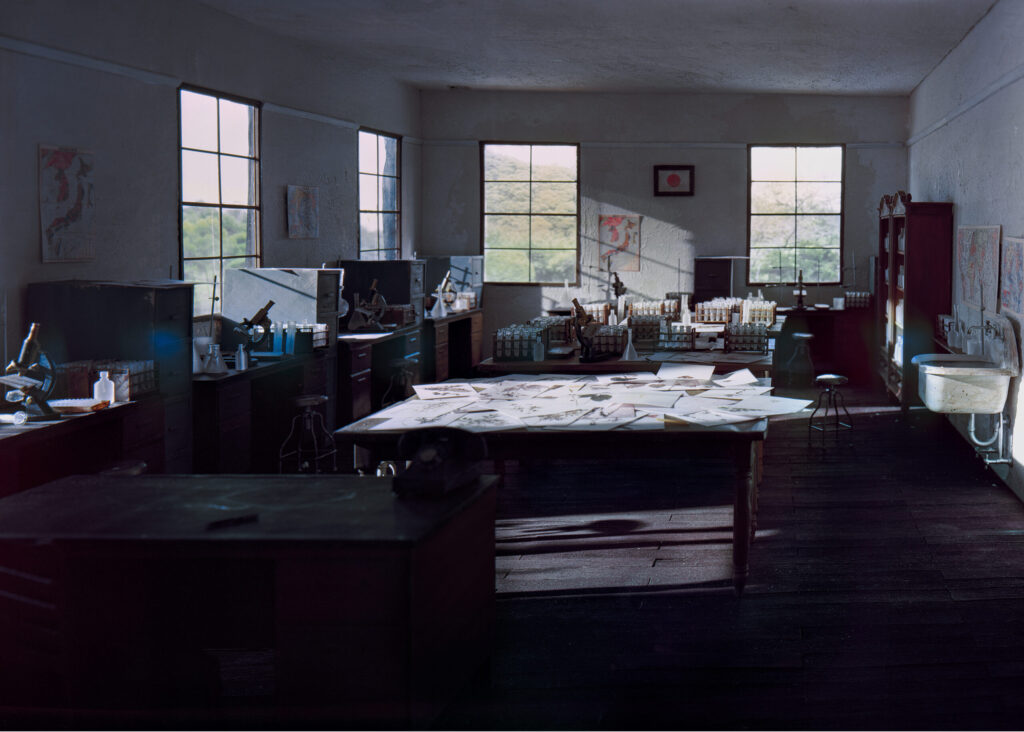
With his photographs of meticulously crafted dioramas depicting the sites of historically significant events, Jewan Goo exposes the formal mechanisms by which state histories reproduce themselves, incisively reframing the archive as both a spatial and ideological apparatus. Rather than working directly with archival materials, Goo fabricates dioramas that restage the institutional spaces where hegemonic knowledge is produced, codified, and enforced—classrooms, science labs, civic ceremonies, ethnographic displays, and so on. In The Japanese Botanists Cataloging Korean Endemic Species 1 (2024), for example—an image depicting the sun-drenched laboratory of Tokyo’s Koishikawa Botanical Garden—Goo revisits Japan’s colonial classification of Korean flora, where what appeared to be neutral science was in fact a tool of domination, rendering the landscape “legible” through taxonomies that erased cultural meaning and reframed native species as imperial resources. Goo makes visible how scientific practice itself became a site of governance and ecological control. Not only are his images void of human figures: through his process, the artist himself becomes a kind of machinic proxy, staging and capturing historical scenes with the cold precision of the very apparatuses he critiques. The machinic labor of reconstruction becomes a counter-visual strategy. Goo’s technique mirrors the aesthetic operation of institutional authority but transforms it into a tool of critique. By collapsing documentation and fiction, scale and spectacle, his work exposes the constructedness of history.
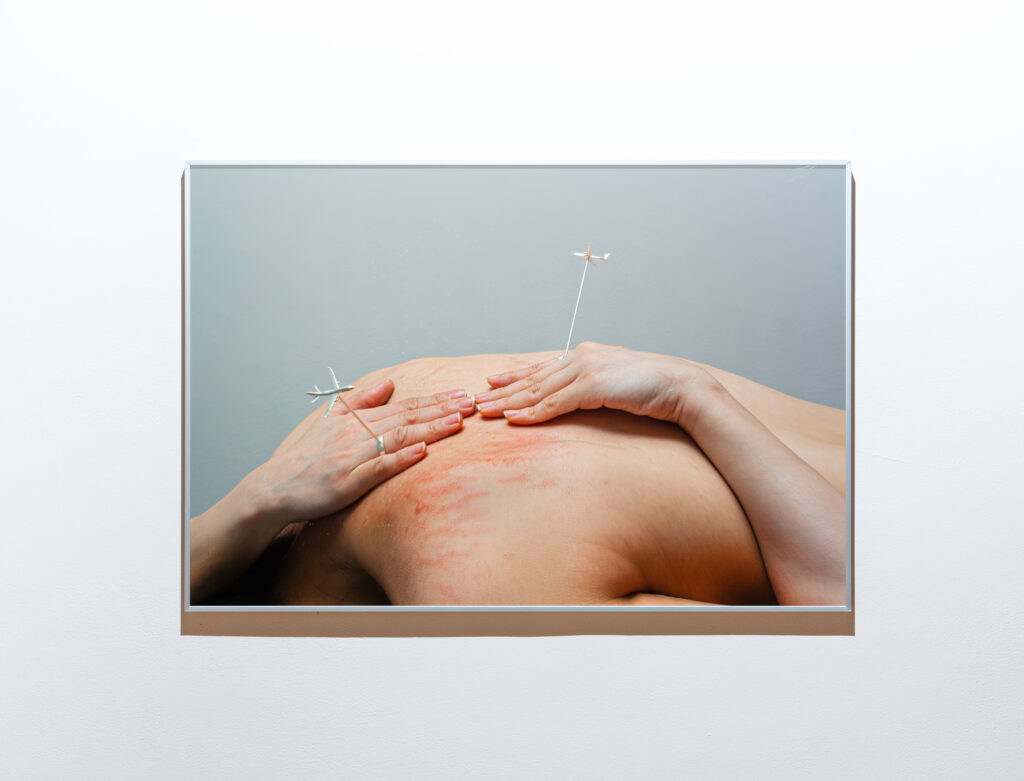
If Goo’s approach mimics hollowed machinic reconstruction, Park builds speculative beings and scenes that are affectively full. She creates unstable assemblages and bodies that are part animal, part machine, and part mythological or familial figure. Her materials—beeswax, terracotta, LEDs, Korean paper, steel, bones—suggest an oscillation between ancient ritual and speculative technology. Even when their references are opaque, Park’s forms are affectively resonant, evoking grief, care, and cultural transmission across generations. Take, as one particularly pertinent example, her 2025 exhibition Bones Between Air: an inflatable airplane that floats, but does not fly, held aloft by decorative string lights repurposed as tethers while simultaneously suggesting a starry sky. With the addition of a flock of miniature papier-mâché planes, the scene at once suggests a migrating family of bird-planes and a mass exodus of hundreds of tiny passengers. Elsewhere in her work, live plants, animal bones, and AIBO robot dogs collide in cyborg assemblages. A trio of sculptures collectively titled Three Bodies of Cerberus refers to the three-headed dog of Greek mythology, reimagining the referenced beast as three individual sculptures, as if to fold the mythical creatures’ supernatural, tripartite physiognomy back into agreement with nature. The ambiguity between these readings is precisely what makes Park’s work a potent rethinking of generational transmission—not as a linear matter of biology, but as cyclical, trans-species, and inter-systemic.
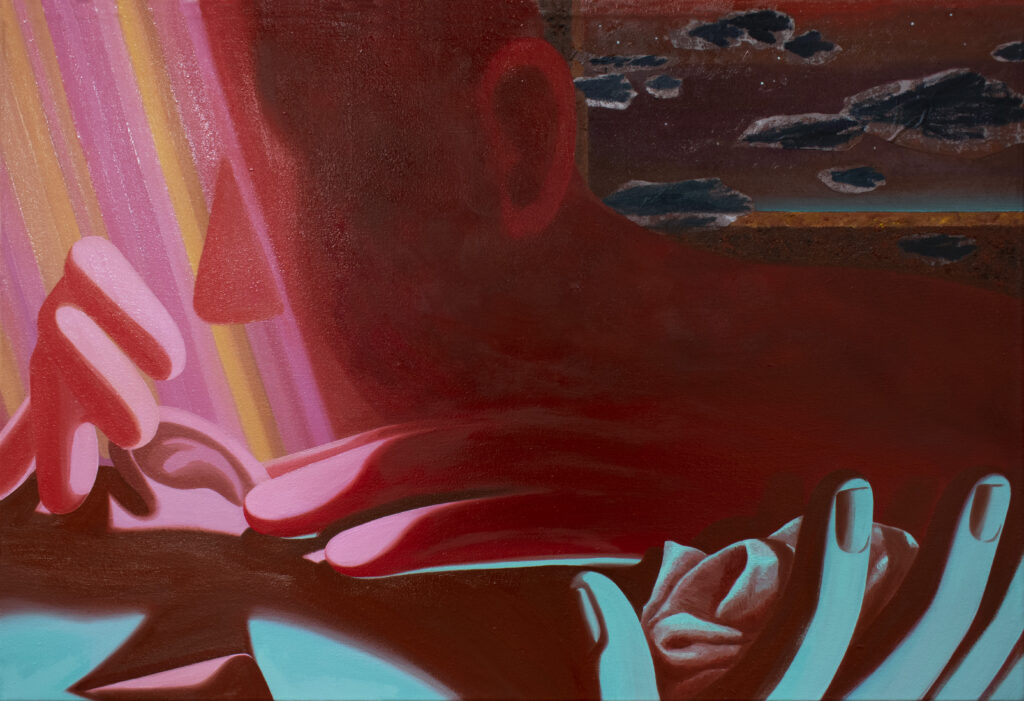
If Hejoo Kim’s work, at first glance, appears the most traditional among the three, it is no less invested in the displacement of presence in its conventional sense. Her paintings employ a subtle visual language in which flattening becomes a generative force. Refusing the conventions of naturalist figuration, Kim explores the affective and ethical capacities of non-identity. The figures that populate her paintings are dimensionless proxies: they evoke emojis, mannequins, or ISOTYPE pictograms—forms intended for mass readability rather than nuanced expression. They are compellingly non-specific, inhabiting spaces shaped by Kim’s vivid color outlines and compositional tilts, all emphasizing formal tension over illusionism. Like Goo, Kim enacts a machinic compression of the human, stripping figuration of depth, expression, and narrative. The flatness of her compositions and their forced perspective, bright outlines, and affective stillness produce bodies that are at once familiar and generic. They resist individuality, functioning instead as placeholders—avatars of emotion, presence, and relation abstracted into signs. The result is a pictorial world where perspective is gently destabilized and intimacy is rendered not through detail but through posture, gesture, and proximity in a surreal plane.
Working across very different mediums, these artists each refuse stable figuration as the ground of meaning. Their strategies of erasure, hybridization, and compression reveal how the figure is no longer a secure site for presence, memory, or relation, but instead a contested field shaped by technological mediation, colonial history, and cultural transmission. In this sense, their works speak to broader contemporary pressures: algorithmic image circulation, ecological collapse, and the commodification of identity. If Goo reveals the machinic coldness of historical apparatuses, Park reanimates affective bonds across species and systems, and Kim distills figuration into a shared visual code.
Goo, Park, and Kim each destabilize the figure—whether by displacing it entirely, hybridizing it, or compressing it—offering reimaginings of what it means to represent presence, emotion, memory, or relation. At a time when identity, memory, and authorship are under stark pressure—from technology, from politics, and from history—these artists model new strategies for how to be present. In refusing to stabilize the figure, their practices remind us that presence may no longer guarantee recognition, but it can still generate new forms of belonging and critique.
Ian Wallace
Associate Curator, Amant
Ian received his PhD in Art History from the CUNY Graduate Center in 2021 with a dissertation focused on the work of artist Charlotte Posenenske. His research centers on the concept of value in modern and contemporary art, art’s capacity to address pressing social issues, and the “lives” of conceptual practices in institutional collections. He has previously worked at Fondazione Prada, the Museum of Modern Art, Dia Art Foundation, and the New Museum, and has contributed to exhibitions at La Fondazione Emilio e Annabianca Vedova (Venice), the International Studio and Curatorial Program (Brooklyn), the Museum of Jurassic Technology (Los Angeles), and Städtische Galerie im Lenbachhaus und Kunstbau (Munich). In 2022, he served as Assistant to the Curator of the 59th Venice Biennale, The Milk of Dreams.
This exhibition is supported by the T&W Foundation, the New York City Department of Cultural Affairs, and the Asian American Arts Alliance (A4). This program is supported, in part, by public funds from the New York City Department of Cultural Affairs in partnership with the City Council.
About the AHL-T&W Foundation Contemporary Visual Art Awards
Established in 2003, the Contemporary Visual Art Awards is an annual competition open to all contemporary artists of Korean descent active in the United States and is part of AHL Foundation’s core program. The awards recognize the work of exemplary young emerging contemporary artists of Korean descent and provide them with a monetary prize and the opportunity to have their work presented at a group exhibition in New York. Since 2016, the award has been generously supported by the T&W Foundation, established by Wonsook Kim and Thomas Park Clement.
About Artists
Jewan Goo
The Japanese Botanists Cataloging Korean Endemic Species 1, 2024, Dye-sublimation print on polyester fabric, mounted in LED lightbox of a diorama photograph, 64 x 89.5 in
Jewan Goo (b. 1994, Seoul, South Korea) is a research-based artist whose image-based practice interrogates colonial juridical visibility through the analytic frameworks of visual culture studies and critical theory. His practice mobilizes forensic excavation and countervisual strategies to expose the regimes of documentation and legal architectures that engineer historical legitimacy and codify ideological narratives within state archives. Drawing on postcustodial archival theory and decolonial praxis, Goo engages in palimpsestic interventions, reconstructing visually undocumented histories and revealing the epistemic violence embedded in archival silences. By treating shadow archives as contested sites, he asserts representational sovereignty and recuperates subjugated knowledge through images that challenge institutional authority and disrupt hegemonic frameworks. His research excavates how imperial scopic regimes, spatial dispositifs, and juridical infrastructures structure exclusion, mediate access to collective narratives, and naturalize power. Grounded in the analysis of state apparatuses and disciplinary power, Goo reconstructs the ways institutionalized epistemologies shape the perceptual and symbolic orders of the present. Goo holds an MFA from the University of Pennsylvania and is a 2025–2027 Core Program Fellow at the Museum of Fine Arts, Houston.
Heejo Kim
Messenger, 2025, Oil and rice paper on canvas, 24 1/2 x 36 in
Heejo Kim (b. 1995, Seoul, South Korea) received an MFA degree in May 2023 from the LeRoy E. Hoffberger School of Painting program at the Maryland Institute College of Art in Baltimore, MD. She received her BFA from the Painting program at Hongik University in Seoul, South Korea, in 2018. Kim’s figurative oil paintings focus on reestablishing identity and existence through relationships with others and objects. Her practice explores ambiguity by dissolving visible markers of identity such as gender, age, and ethnicity, allowing her figures to quietly “be” rather than act. Informed by the Buddhist concept of Dependent Arising (Yeongi-sull) and Roland Barthes’s notion of tenderness as an ethical mode of being-with, Kim’s work embraces the uncertain space between self and other, where understanding is incomplete but connection is still possible. Her figures linger in stillness, their gestures whispering a quiet will.
Hyunjin Park
Two Ends of One, 2025, Digital print, 27 x 40 in
Hyunjin Park (b. 1991, Seoul, South Korea) is an interdisciplinary artist and researcher based in New York and Seoul. Working across performance, video, installation, and sculpture, Park explores the affective presence of non-human beings — from living creatures to machines — and how they unsettle boundaries between the modern and the ancient, life and death, and the human and the non-human. Her solo exhibitions include Gallery OOOJH in Seoul (2022), as well as Gallery Chamber in Seoul and Openspace Bae in Busan, both in 2025. Selected as a Kumho Young Artist, she will present a solo exhibition at Kumho Museum of Arts in 2026. She has also participated in group exhibitions at venues such as the Total Museum (Seoul), Onsugonggan (Seoul), and Hui Gallery (Hong Kong), among others. Park has been selected for several international residency programs, including Domaine de Boisbuchet in Lessac, France (2024, supported by the Youngmin International Art Program), the Vermont Studio Center in Johnson, VT (2024, fellowship), the Wassaic Project in Wassiac, NY (2025), and the Watermill Center in Water Mill, NY (2025).
About the AHL-T&W Foundation Contemporary Visual Art Awards
Established in 2003, the Contemporary Visual Art Awards is an annual competition open to all contemporary artists of Korean descent active in the United States and is part of AHL Foundation’s core program. The awards recognize the work of exemplary young emerging contemporary artists of Korean descent and provide them with a monetary prize and the opportunity to have their work presented at a group exhibition in New York. Since 2016, the award has been generously supported by the T&W Foundation, established by Wonsook Kim and Thomas Park Clement.
About AHL Foundation
Founded in 2003, the AHL Foundation is a New York–based nonprofit organization dedicated to supporting Korean and Korean American artists through exhibitions, awards, fellowships, and educational programs. By fostering cross-cultural dialogue and increasing the visibility of immigrant and diaspora artists, AHL Foundation continues to strengthen the presence of Korean contemporary art in the United States.
For media inquiries, please contact:
info@ahlfoundation.org
[국문]
알재단, 2025년 AHL-T&W Foundation 현대미술상 수상 작가전 개최
- 전시 기간: 2025년 10월 18일(토) – 2025년 11월 15일(토)
- 갤러리 운영 시간: 수-토 오후 12-6시
- 장소: 알재단 갤러리(2605 Frederick Douglass Blvd. #C1, New York, NY 10030)
- 기획: 이안 월리스 (Ian Wallace)
- 참여 작가: 구제완(Jewan Goo), 김희조(Heejo Kim), 박현진(Hyunjin Park)
- 오프닝 리셉션: 2025년 10월 18일(토) 오후 3-5시
비영리 한인 미술인 지원 단체 알재단(AHL Foundation, 대표 이숙녀)이 2025년도 AHL-T&W 현대미술상 수상 작가전을 오는 10월 18일(텨) 알재단 갤러리(2605 Frederick Douglass Blvd., #C1, New York NY 10030)에서 개최한다. 본 전시는 2025 AHL-T&W 현대미술상 심사위원이자 아만트(Amant) 큐레이터인 이안 월리스(Ian Wallace)가 기획했으며, 올해 AHL-T&W Foundation 현대미술상 수상자로 선정된 3인, 구제완(Jewan Goo), 김희조(Heejo Kim), 박현진(Hyunjin Park) 작가의 사진, 회화, 설치 등 다양한 매체의 작품을 선보인다.
전시는 이안 월리스가 글의 서두에서 제시한 ‘현존(presence)’이라는 개념을 바탕으로, AI 생성 이미지와 알고리즘이 일상을 매개하는 오늘날의 시각 환경 속에서 정체성과 가시성이 어떻게 끊임없이 불안정해지고 재구성되는지를 탐구한다. 세 작가는 각기 다른 예술적 전략을 통해 인간과 기계, 역사와 기술, 사실과 허구의 경계를 넘나들며, 디지털 문화 속에서 ‘존재한다’는 것의 의미를 새롭게 사유한다.
이번 전시에서 구제완은 정교하게 구성된 디오라마 사진을 통해 국가 권력과 식민지 지식 체계의 구조를 드러내고, 박현진은 유기적 재료와 기술적 요소가 결합된 감성적 설치 작업을 통해 세대 간 기억과 문화적 전승의 층위를 탐구한다. 한편 김희조는 인간 형상을 평면적이고 선명한 윤곽선의 형태로 압축해, 비현실적인 회화적 공간 속에서 시점(perspective)을 흔들고, 자세와 몸짓, 거리감을 통해 새로운 친밀감의 감각을 만들어낸다.
“많은 재능 있는 지원자들 가운데 신중한 심사를 거쳐 선정된 세 명의 뛰어난 작가들과 함께 알재단 갤러에서 전시를 열게 되어 매우 기쁩니다. 이번 전시를 통해 수상 작가들이 예술적 여정을 한층 확장하고, 미국 미술계 속에서 한국 작가로서의 존재감을 더욱 강화할 수 있기를 바랍니다.” 라고 이숙녀 알재단 회장은 전시 개최 소감을 밝혔다.
한편, 알재단의 설립과 동시에 시작된 현대 미술 공모전은 2003년 창설이래 매년 미국에서 활동하는 한국계 미술인이면 누구나 지원 할 수 있는 알재단의 주요 프로그램 중 하나이다. 2016년 부터는 중견 화가이자 문화 후원가인 김원숙씨와 토마스 클레멘트(Thomas Park Clement)씨가 설립한 T&W 재단의 후원으로 운영하고 있다.
참여 작가
구제완 (b. 1994, Seoul, South Korea)은 시각문화 연구와 비판이론의 분석적 틀을 통해 식민주의적 법적 시각체계(colonial juridical visibility)를 탐구하는 리서치 기반 작가이다. 그는 포렌식적 발굴(forensic excavation)과 대응적 시각 전략(countervisual strategies)을 통해 국가 아카이브 내에서 역사적 정당성을 구축하고 이데올로기적 서사를 체계화하는 기록 및 법적 구조의 체제를 드러낸다. ‘탈보관(postcustodial)’ 아카이브 이론과 탈식민 실천(decolonial praxis)을 바탕으로, 그는 시각적으로 기록되지 않은 역사를 재구성하고 아카이브의 침묵 속에 내재된 인식론적 폭력을 드러내는 ‘팔림프세스트적介入(palimpsestic interventions)’을 수행한다. 그는 ‘그림자 아카이브(shadow archives)’를 논쟁의 장으로 삼아 제도적 권위를 흔드는 이미지를 통해 표현의 주권을 회복하고, 억압된 지식을 복원한다. 구제완의 연구는 제국주의적 시선 체계, 공간적 장치(spatial dispositifs), 법적 인프라가 어떻게 배제 구조를 형성하고, 집단적 서사에 대한 접근을 매개하며, 권력을 자연화하는지를 파헤친다. 국가 장치(state apparatus)와 규율 권력(disciplinary power)에 대한 분석을 바탕으로, 그는 제도화된 인식론이 오늘날의 지각적·상징적 질서를 어떻게 형성하는지를 재구성한다. 그는 펜실베이니아 대학교에서 석사학위를 취득했으며, 휴스턴 미술관(Museum of Fine Arts, Houston)의 2025–2027 코어 프로그램 펠로우이다.
김희조 (b. 1995, Seoul, South Korea) 는 2023년 미국 메릴랜드주 볼티모어의 메릴랜드 미술대학(Maryland Institute College of Art) LeRoy E. Hoffberger 회화 프로그램에서 석사학위를 취득했으며, 2018년 서울 홍익대학교 회화과를 졸업했다. 그의 인물 중심 유화 작업은 타자 및 사물과의 관계를 통해 정체성과 존재를 재정립하는 데 초점을 둔다. 김희조는 성별, 나이, 인종과 같은 가시적 정체성의 표식을 해체함으로써 인물들이 ‘행동’하기보다 조용히 ‘존재’하도록 만든다. 불교의 ‘연기(緣起, Dependent Arising)’ 개념과 롤랑 바르트(Roland Barthes)의 ‘온유함(tenderness)’ 개념에 영감을 받아, 그의 작업은 완전한 이해는 불가능하지만 여전히 연결이 가능한 ‘자기와 타자 사이의 불확실한 공간’을 탐색한다. 그의 인물들은 고요 속에 머무르며, 그들의 몸짓은 조용한 의지를 속삭이듯 존재한다.
박현진 (b. 1991, Seoul, South Korea)은 뉴욕과 서울을 기반으로 활동하는 조각, 영상, 퍼포먼스, 설치 작가이자 연구자로, 인간과 비인간동물 사이의 역사적이고 정서적인 연결을 추적하며, 현대와 과거, 삶과 죽음, 인간, 동물, 기계 사이에 그어진 경계들이 어떻게 흐려지는지를 탐구한다. 개인전으로는 2022년 갤러리 의외의조합, 2025년에는 챔버(서울)와 오픈스페이스 배(부산)이 있고, 금호미술관에서 2026년 개인전이 예정되어 있다. 또한 토탈미술관, 온수공간, 홍콩 후이 갤러리 등에서 열린 단체전에 참여했고, 한화 영민문화재단 선정 작가로 프랑스 Domaine de Boisbuchet(2024)에 참여했고, 버몬트 스튜디오 센터 펠로우십(2024), 와사익 프로젝트(2025), 워터밀 센터 레지던시(2025) 등 다수의 국제 레지던시에 선정되었다.